The book
A measurement playbook, not another dashboard
and start measuring what actually drives revenue
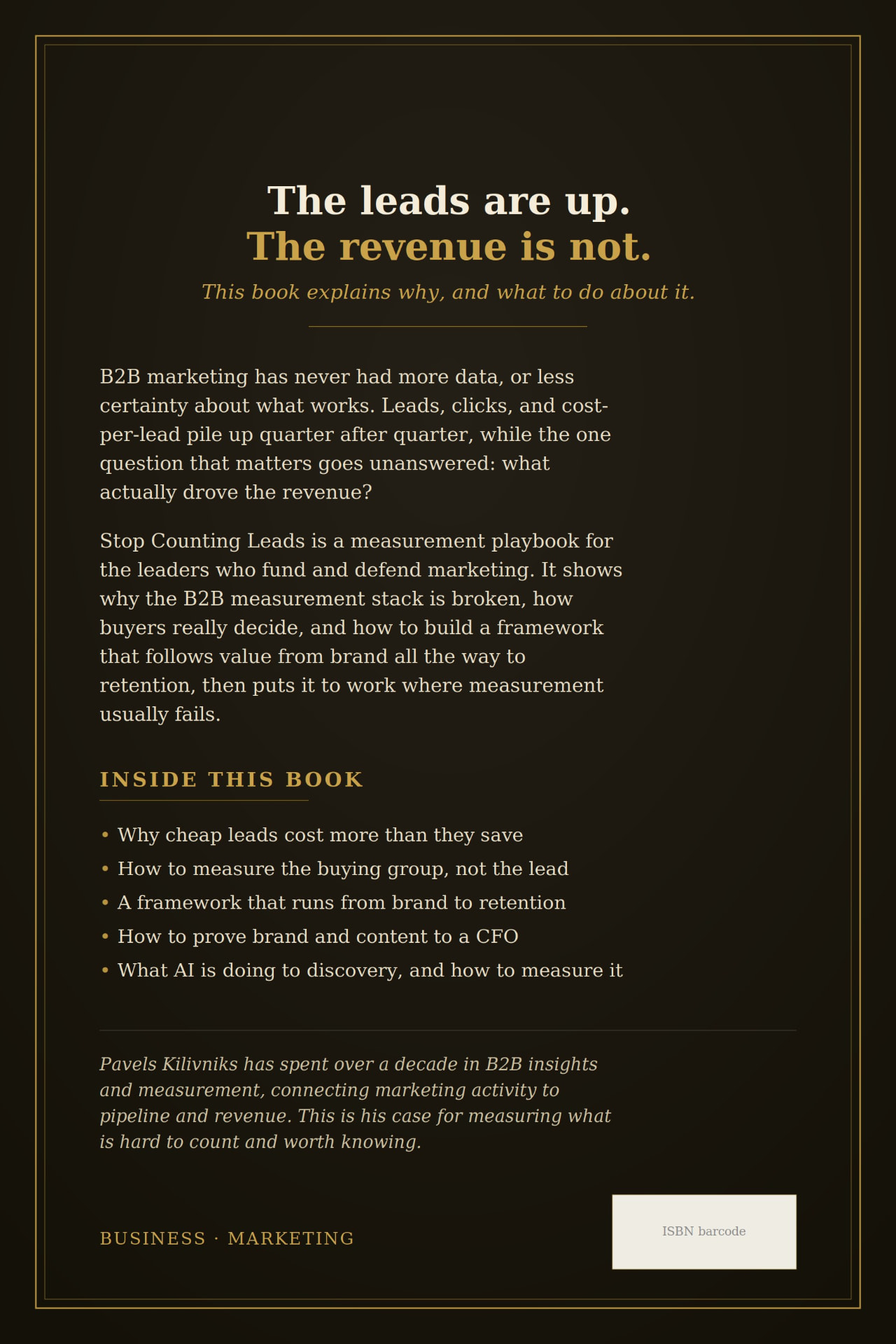
B2B marketing has never had more data, or less certainty about what works.
Leads, clicks, cost-per-lead, and qualified-lead counts pile up quarter after quarter. Still, no one can answer the question the board keeps asking. What drove the revenue?
Effort is not the problem. The measurement system is. It was built to reward the numbers that are easy to produce, and those numbers rarely explain what moved a deal.
Stop Counting Leads is a measurement playbook for the people who fund marketing and answer for it. Pavels Kilivniks has spent more than a decade in B2B insights and measurement. He shows why the usual stack fails, and how to replace it with a system that follows value from brand to retention.
From there the book goes into the places where measurement usually breaks. The metrics that should change as a company grows. Brand spend that has to be justified to a CFO. Content that pays off long after the campaign ends. Account-based programs that only work when sales and marketing share one view. And the newest problem of all, the AI tools that now shape how buyers research vendors before they ever reach your site.
The book has no patience for vanity metrics. It makes the case for measuring what is hard to count and worth knowing. It was written for the CMO who is tired of defending the wrong numbers, and for the CEO and CFO who pay for them.
Inside, you will find how to
- Stop paying for cheap leads. Low cost-per-lead looks like efficiency until you follow the money. See why cheap leads cost more than they save.
- Measure the buying group. Deals are decided by committees, not by the one person who filled out a form. Measure the group that actually buys.
- Created vs. captured demand. Separate the demand you created from the demand you only harvested, so credit lands where the work happened.
- Correlation vs. causation. Practical tests that keep you from crediting luck, seasonality, or someone else's pipeline.
- Brand and content, for a CFO. Make the financial case for the spend that pays off long after the campaign ends, in language finance accepts.
- Visibility inside AI tools. Buyers now research vendors through AI assistants. Check whether those tools mention you, and track it over time.
- Answer the board with a method. Replace the shrug with a defensible framework that follows value from brand all the way to retention.
Also included
- 25-question executive diagnostic. A structured audit of your current measurement system, sized for a leadership meeting.
- Plain-language glossary. Measurement terms defined without jargon, so the whole leadership team argues about the same thing.
- One-page framework reference. The full brand-to-retention framework on a single page you can put in front of a board.
- Ready-to-use templates. Working documents you can adapt this quarter instead of rebuilding from scratch.
Free download
Start with the executive diagnostic
Twenty-five questions that reveal where your measurement system is guessing.